
A chronic illness support group is a structured community space where people affected by chronic health conditions share experiences, receive emotional validation, and access practical coping strategies together. These groups, also called peer support communities or illness support networks, operate on recurring schedules and serve patients, caregivers, and families alike. Social support is a critical health intervention that reduces loneliness and strengthens self-advocacy. Finding the right chronic illness support group can genuinely change how you manage your condition, not just emotionally, but physically too.
What types of chronic illness support groups exist?
Not all support groups work the same way, and that difference matters enormously when you are already exhausted and in pain.
Peer-led groups are run by people who live with chronic illness themselves. They are almost always free, which removes a real barrier for people managing medical costs. Clinician-led groups are facilitated by licensed therapists or social workers. These often require a 60-dollar intake assessment before you join, which screens for mental stability and ensures the group is a good fit for you. That screening is not a gatekeeping exercise. It protects everyone in the room, including you.
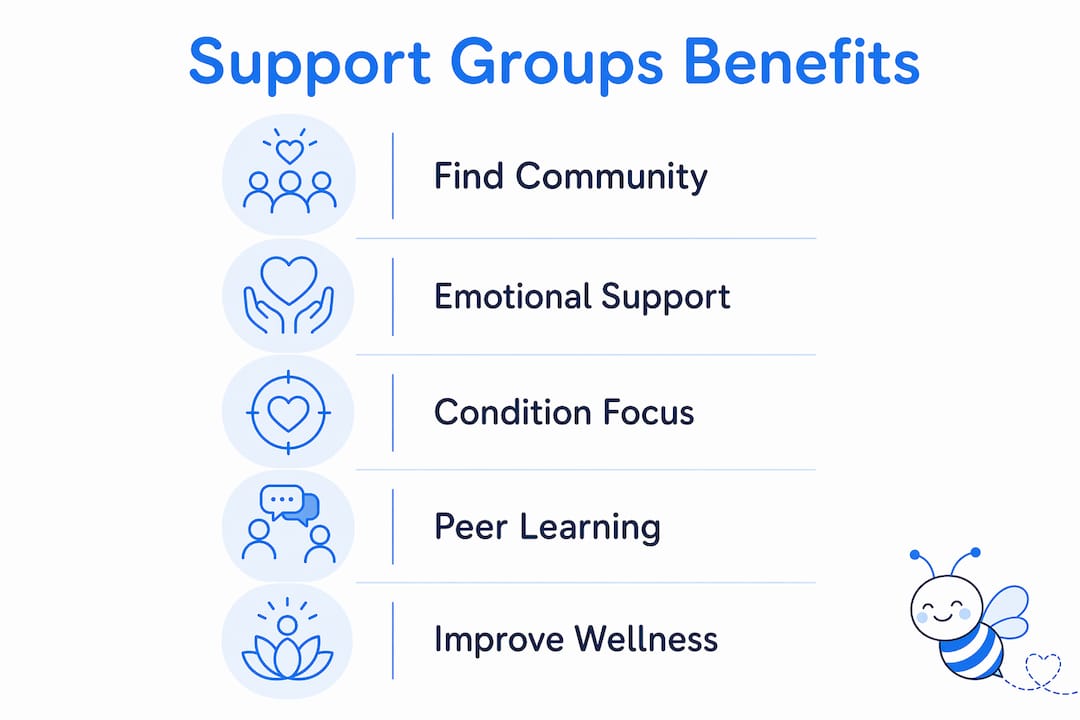
Condition-specific groups focus on a single diagnosis, such as Lyme disease, Morgellons, lupus, or fibromyalgia. The shared vocabulary in these spaces is remarkable. You do not have to explain what a flare feels like. General chronic illness communities welcome anyone managing a long-term condition, which can expose you to coping strategies from people fighting very different battles.

Online versus in-person is the other major divide. Online communities often use asynchronous participation, letting members engage without turning on a camera or speaking live. That flexibility is not a lesser option. For people with unpredictable energy levels, it is the only option that actually works.
| Format | Cost | Best for |
|---|---|---|
| Peer-led, in-person | Free | Connection, shared lived experience |
| Clinician-led, in-person | Intake fee (~$60) | Structured emotional processing |
| Online, synchronous | Varies | Real-time connection with flexibility |
| Online, asynchronous | Often free | Low-energy days, time-zone differences |
- Peer-led groups: no professional oversight, but authentic shared experience
- Clinician-led groups: structured, screened, and therapeutically grounded
- Condition-specific groups: deep shared vocabulary and targeted advice
- General chronic illness communities: broader perspective and diverse strategies
- Online asynchronous groups: participation on your own schedule and terms
Pro Tip: Search for groups through the National Alliance on Mental Illness (NAMI), which hosts condition-inclusive chronic illness support groups on a recurring schedule in many cities.
How do support groups improve mental health and chronic illness management?
Consistent peer engagement improves emotional outcomes and strengthens self-advocacy in chronic illness management. That is not a soft benefit. It is a measurable shift in how people navigate their own care.
“Support communities provide reality checks on fears and help patients navigate medical systems. Their primary role is to separate realistic concerns from panic during symptom flares.”
That quote captures something doctors rarely have time to offer. When your symptoms spike at 2:00 AM and you spiral into worst-case thinking, a community that has been there grounds you fast.
Here is how support groups produce real mental health gains:
- Emotional validation. Hearing “I felt that too” from someone who genuinely means it breaks the isolation that chronic illness creates.
- Shared coping strategies. Members trade practical techniques, from pacing methods to sleep protocols, that no clinical pamphlet covers.
- Reduced depression risk. Social isolation worsens outcomes in chronic illness. Support groups directly counter that risk.
- Medical navigation support. Groups help members ask better questions, push back on dismissive diagnoses, and find specialists who take their conditions seriously.
- Sustained hope. Seeing someone further along in their management than you are is one of the most powerful motivators available.
Support groups complement medical treatment. They do not replace it. A good group will tell you that plainly. The goal is emotional grounding and practical resilience, not a cure.
What should you expect when joining a chronic illness support group?
Sessions typically last 60–90 minutes and meet bi-weekly or monthly. That rhythm matters because it is frequent enough to build real relationships but not so demanding that it drains you.
Clinician-led groups usually require a 30-minute intake session before your first group meeting. The intake assesses your current mental health status and confirms the group’s focus aligns with your needs. Think of it as a mutual interview. You are also deciding whether this group fits you.
Here is what to expect once you are inside:
- Open groups allow new members to join at any time. Closed groups run for a fixed number of sessions with the same people throughout.
- Camera-optional norms are common in online groups. Many members listen only for the first few sessions before speaking. That is completely normal and respected.
- No cross-talk rules protect members from unsolicited advice. You share; others listen. Feedback comes only when invited.
- Confidentiality agreements are standard. What is said in the group stays there.
- Rotating facilitation sometimes occurs in peer-led groups, giving members shared ownership of the space.
Pro Tip: Attend at least three sessions before deciding whether a group is right for you. The first session is almost always the most uncomfortable, and it rarely reflects the ongoing experience.
Caregivers benefit from these spaces too. If you are supporting someone with a chronic condition, a caregiver-focused support group addresses the specific weight you carry, which is different from what the patient experiences.
How do you build a sustainable chronic illness support system?
Distributing emotional and practical support across multiple channels prevents burnout and builds long-term resilience. Relying on one group, one friend, or one therapist for everything is a setup for exhaustion on both sides.
A balanced support portfolio combines condition-specific peer groups with broader mental health therapy and produces better emotional resilience than any single source alone. Think of it as spreading weight across multiple load-bearing points.
| Support type | Primary function | Frequency |
|---|---|---|
| Chronic illness peer group | Shared experience, validation | Bi-weekly or monthly |
| Individual therapy | Deep emotional processing | Weekly or bi-weekly |
| Family or close friends | Practical help, daily connection | Ongoing |
| Online async community | Low-pressure engagement | As needed |
| Medical team | Clinical management | Per treatment plan |
Practical strategies for building this system without burning out:
- Assign different needs to different sources. Your support group is not your therapist, and your therapist is not your friend group.
- Use online communities on high-symptom days when in-person connection is impossible.
- Check in with your chronic illness support network regularly, even briefly, rather than disappearing and re-emerging only in crisis.
- Protect your energy by setting a participation limit. Two or three sources of active engagement is enough for most people.
Consistent low-pressure check-ins sustain connections better than occasional grand gestures. A two-sentence message in a group chat counts. Showing up matters more than showing up perfectly.
Key Takeaways
A chronic illness support group works best when it is one part of a broader, distributed support system rather than a patient’s sole source of emotional and practical help.
| Point | Details |
|---|---|
| Group types vary widely | Peer-led groups are free; clinician-led groups require an intake assessment around $60. |
| Sessions follow a predictable rhythm | Most groups meet bi-weekly or monthly for 60–90 minutes per session. |
| Mental health benefits are real | Peer engagement reduces isolation, improves self-advocacy, and counters depression risk. |
| Online groups fill critical gaps | Asynchronous participation accommodates fluctuating energy without social pressure. |
| Diversify your support sources | Spreading support across groups, therapy, family, and online communities prevents burnout. |
What I have learned about support groups that nobody tells you
I spent a long time thinking I had to show up to a support group ready to talk. I thought silence meant I was doing it wrong. That belief kept me out of groups for longer than I care to admit, and it cost me.
The truth is that the most valuable thing a support group gave me was permission to not be okay without having to explain it. You do not need to perform your suffering or summarize your medical history in the first session. You can sit there, listen, and feel less alone. That alone is worth more than most people realize until they experience it.
What I also learned the hard way: not every group is your group. I tried two before I found one that fit. The first felt clinical and cold. The second was so focused on venting that it left me feeling worse. The third was the one where I finally exhaled. If a group does not feel right after three or four sessions, leave without guilt and try another. You are not failing. You are being honest about your needs.
For those of us dealing with conditions like Morgellons or Lyme, where the medical community often dismisses or misunderstands us, a group of people who get it is not a luxury. It is a lifeline. The impact on family dynamics alone makes finding community worth the effort. You deserve people in your corner who do not need convincing that your pain is real.
— Megan
Megansmiraclestudio resources for chronic illness wellness
Living with a chronic illness means fighting on multiple fronts at once. Emotional support from a peer community is one piece of that fight. Physical support is another.
Megansmiraclestudio carries a range of supplements and internal detox products designed specifically for people managing complex chronic conditions like Morgellons and Lyme disease. The site also offers apitherapy resources, including bee venom therapy kits and educational guides on natural treatment protocols. These tools are built for people who have already done the research and know that conventional options alone are not enough. Megansmiraclestudio exists because this community deserves real support, not just sympathy.
FAQ
What is a chronic illness support group?
A chronic illness support group is a structured community where people with long-term health conditions share experiences, receive emotional validation, and exchange practical coping strategies. Groups may be peer-led or clinician-facilitated and meet in person or online.
How do I find an illness support group near me?
NAMI hosts chronic illness support groups in many cities, and organizations like Lifespan Dynamics connect patients with clinician-facilitated groups across multiple states. Searching condition-specific forums and hospital social work departments also surfaces local options.
Are online chronic illness communities as effective as in-person groups?
Online communities are equally effective for many people, particularly those with fluctuating energy or mobility limitations. Asynchronous formats reduce social pressure and allow participation on your own schedule.
How much does a chronic illness support group cost?
Peer-led groups are typically free. Clinician-led groups often charge around $60 for an initial intake assessment, with ongoing session fees varying by provider.
How many support groups should I join?
One to two active groups is enough for most people. Spreading support across a peer group, individual therapy, and an online community covers emotional, practical, and informational needs without creating additional fatigue.