

Chronic illness symptom journaling is the practice of recording symptoms, severity, and triggers in a structured, time-stamped log to identify patterns and communicate clearly with your healthcare providers. If you are living with Morgellons Disease, Lyme disease, or any other complex chronic condition, you already know how fast the details blur together. One bad week looks like every other bad week. Your doctor has twelve minutes with you, and you can barely remember what happened two days ago, let alone two months ago. Symptom tracking for chronic illness changes that. It gives you real data, real patterns, and real power in the exam room. Tools range from simple notebooks to apps like PatientSpot and wearable integrations like Fitbit, so there is a method that fits your energy level and lifestyle.
What is chronic illness symptom journaling and why does it matter?
A symptom journal is a time-stamped, structured record of your symptoms, including start time, duration, severity, and context like sleep, stress, and medication. The industry term for this practice is symptom diary or patient-reported outcome tracking, and it is used across clinical settings for conditions ranging from migraines to autoimmune disorders to chronic pain. What makes it powerful is not any single entry. It is the pattern that emerges across dozens of entries over weeks and months.
Clinicians cannot see what happens between appointments. When you walk in and say “I’ve been feeling awful,” that tells them almost nothing. When you walk in with a log showing that your pain spikes to an 8 out of 10 every third day, always after poor sleep, and always in your lower back and joints, that tells them everything. Structured entries help clinicians identify patterns for conditions like migraines, allergies, and chronic pain that would otherwise stay invisible.

The benefits of symptom journaling go beyond the doctor’s office. You start to notice your own triggers. You catch small improvements you would have dismissed. You stop second-guessing yourself because the data is right there. For anyone fighting a condition that doctors sometimes dismiss or misunderstand, that kind of self-knowledge is not just useful. It is armor.
What key information should you track in a symptom journal?
Tracking a small, consistent set of high-value data points repeatedly provides the best insights for chronic illness management. You do not need to write an essay every day. You need the right details, recorded consistently.
Here is what to include in every entry:
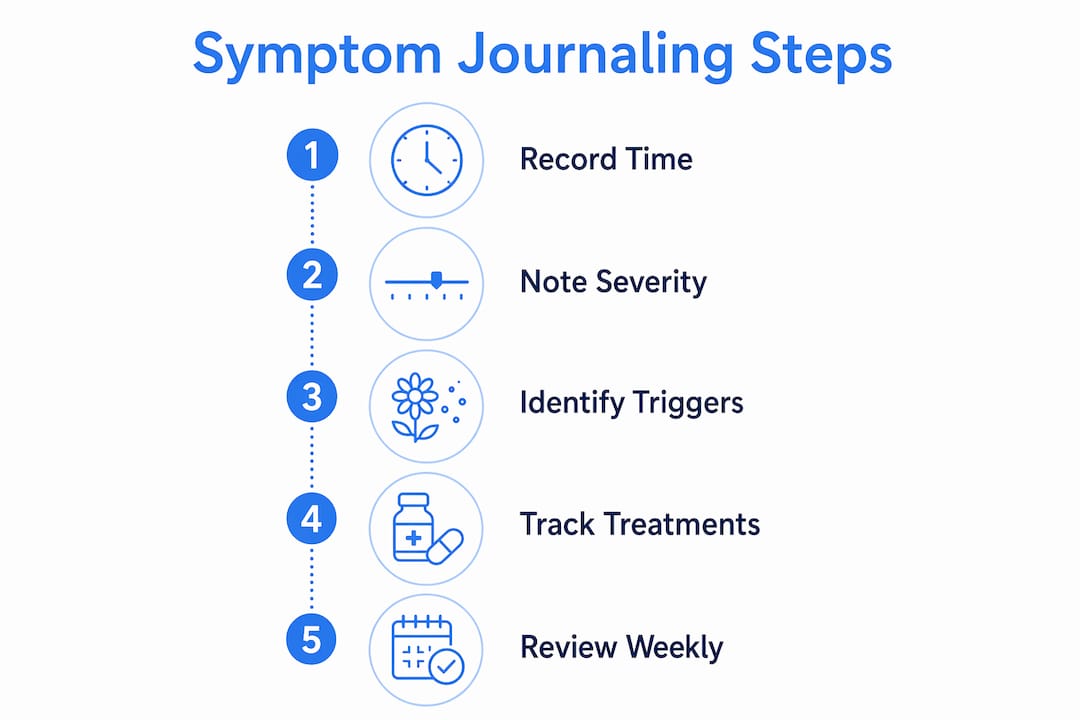
- Date and time of when the symptom started or peaked
- Symptom type and body location (e.g., burning sensation in the left forearm, joint stiffness in both knees)
- Severity rating on a 0 to 10 numeric scale, where 0 means no symptom and 10 means the worst imaginable
- Duration of the symptom episode
- Descriptive quality of the symptom, such as sharp, throbbing, burning, or crawling
- Contextual factors including sleep quality the night before, stress level, physical activity, and mood
- Medications taken, including timing and dosage, and any supplements used
- What helped or made it worse, such as rest, heat, a specific food, or a treatment application
Including treatment timing and adherence context in your entries prevents misattributing symptom changes to the wrong causes. If you started a new supplement three days ago and your symptoms shifted, that connection only shows up if you logged both events.
Pro Tip: Set up a simple template in a notes app or on paper with these eight fields pre-filled. All you do each day is fill in the blanks. This cuts journaling time to under three minutes and removes the mental barrier of starting from scratch.
How do different symptom journaling methods compare?
Choosing the right method is about sustainability, not perfection. Here is how the main options stack up:
| Method | Best for | Key advantage | Main limitation |
|---|---|---|---|
| Paper notebook or planner | Low-tech users, those with screen fatigue | No battery, no login, fully customizable | Hard to search, no automatic reminders |
| Printable symptom templates | Structured thinkers who prefer guided formats | Pre-built fields reduce decision fatigue | Still manual, no data export |
| Apps like PatientSpot | Users who want dashboards and trend views | Visualizes patterns and supports sharing with providers | Requires consistent phone use |
| Wearables with sensor integration | Those who want passive, automatic data capture | Tracks sleep, heart rate, and activity without effort | Expensive, limited symptom specificity |
| Chronic care digital platforms | Complex conditions needing multi-system tracking | Supports provider communication and family access | Learning curve, subscription costs |
Digital chronic disease platforms with symptom diaries and dashboards support trends visualization and secure sharing with healthcare providers and family members. That matters enormously when you are managing something as complex as Lyme disease or Morgellons, where symptoms shift across multiple body systems and providers need context fast.
Paper journals win on simplicity and zero friction. You can grab them at 2 a.m. during a flare without worrying about a dead phone. Apps win on analysis. The helpful recovery tools page at Megansmiraclestudio covers several digital platforms worth exploring if you want to go the tech route.
The honest truth is that the best method is the one you will actually use tomorrow. Start with whatever feels least overwhelming, and upgrade later if you need more structure.
How to maintain journaling consistency without burning out
Keeping symptom journals minimal and manageable is the single most important factor in long-term success. Exhaustive, narrative-style entries feel meaningful at first and then become a burden that you abandon by week three.
These practices keep journaling sustainable:
- Pick one consistent time each day, either morning or evening, so it becomes a habit tied to an existing routine like taking medication or brushing your teeth
- Use scales and checkboxes instead of writing sentences wherever possible; a severity number and a location checkbox take ten seconds
- Avoid explaining yourself in the moment; just log the data and move on
- Set a digital reminder if you use an app; automated reminders and symptom prompts in apps increase adherence and provide cues for worsening symptoms
- Write down questions for your doctor as they occur to you during tracking, not just the night before your appointment; patients who jot questions immediately tend to get better care, even when their logs are incomplete
- Give yourself permission to do less on bad days; a one-line entry that says “severe flare, 9/10, couldn’t get out of bed” is infinitely more useful than no entry at all
The Thriving Spoonie approach to manageable symptom tracking makes this point clearly: the best symptom journal balances completeness with ease, and minimal entries focusing on date, severity, and key context work best during low-energy days. That is not a compromise. That is smart design.
Pro Tip: Review your last two weeks of entries every Sunday for ten minutes. Look for one pattern, one trigger, or one question to bring to your next appointment. This weekly review turns raw data into something you can actually use.
For more on building sustainable habits around chronic illness self-care, the patient advocacy tips at Megansmiraclestudio are worth reading alongside this.
How to use your symptom journal to improve healthcare communication
Turning raw logs into short, readable summaries before doctor visits enhances communication, and patterns need tracking across a few cycles, ideally two weeks to three months, before the data becomes truly actionable. Doctors prefer brief summaries highlighting frequency, intensity, timing, and location over voluminous daily notes. Your job is to translate your journal into something a clinician can absorb in ninety seconds.
Here is a practical process for doing that:
- Pull your last two to four weeks of entries and look for recurring symptoms, not one-off events
- Note the frequency and timing of each recurring symptom (e.g., “joint pain occurring 4 to 5 days per week, peaking in the morning”)
- Identify your top two or three patterns to highlight, rather than presenting every data point
- List any treatment or medication changes you made during the tracking period and whether symptoms shifted afterward
- Write two to three specific questions based on what you observed, such as “My pain consistently spikes after poor sleep. Could we discuss sleep support options?”
- Export or print a summary if your app supports it, or write a half-page handwritten summary to bring to the appointment
Clinicians prioritize identifiable patterns from symptom logs over narrative details given limited appointment time. A one-page summary with three clear patterns and two direct questions will do more for your care than a binder full of daily notes.
If you are working with providers around alternative therapies, the Megansmiraclestudio guide on communicating with doctors about non-traditional treatments pairs well with a solid symptom journal. Your data makes those conversations far less adversarial.
Pro Tip: Phrase your symptom reports as observations, not complaints. “My data shows pain averaging 7 out of 10 on days following less than six hours of sleep” lands differently than “I’ve been in so much pain.” The first invites problem-solving. The second invites sympathy but rarely action.
Key takeaways
Symptom journaling works because consistent, structured data transforms vague suffering into identifiable patterns that both you and your providers can act on.
| Point | Details |
|---|---|
| Core purpose | A symptom journal records severity, triggers, and context to reveal patterns invisible to clinicians between visits. |
| What to track | Log date, severity on a 0 to 10 scale, location, duration, mood, sleep, and medication timing every entry. |
| Method choice | Pick the tool you will use consistently; paper works for simplicity, apps like PatientSpot work for trend analysis. |
| Avoid burnout | Keep entries short, use scales over sentences, and allow minimal entries on flare days to stay consistent. |
| Provider communication | Summarize two to four weeks of data into three patterns and two questions before every appointment. |
What I’ve learned from years of tracking symptoms with chronic illness
I will be honest with you. When I first started keeping a symptom journal, I hated it. It felt like one more thing to do on days when getting out of bed was already a victory. I over-complicated it, tried to explain everything, and burned out within two weeks. Sound familiar?
What changed everything for me was stripping it down to almost nothing. Date. Number. Location. That’s it on the worst days. I stopped trying to make my journal perfect and started making it real. And slowly, something shifted. I started seeing my own patterns. I noticed that certain supplements were actually moving the needle, but only when I tracked consistently enough to see the before and after. I walked into appointments with data instead of desperation, and my providers started taking me more seriously.
The thing nobody tells you about how to journal chronic illness is that the goal is not a beautiful, complete record. The goal is enough data to fight for yourself. A symptom journal gave me back a sense of control during a time when my body felt completely out of my hands. It is not a cure. But it is power. And when you are suffering, power matters more than you can imagine.
If you are just starting out, please do not wait until you have the perfect system. Start with a sticky note and a number. Build from there.
— Megan
Support your symptom management with Megan’s Miracle natural products
Symptom journaling tells you what is happening in your body. Megansmiraclestudio exists to help you do something about it. Once your journal starts revealing patterns, like persistent inflammation, immune disruption, or systemic fatigue, you can begin pairing those insights with targeted natural support. The supplements and internal detox collection at Megansmiraclestudio includes options like Snow Mushroom Polysaccharide Capsules for immune and systemic support, and the Medical Grade Bee Venom Therapy Kit for targeted pain and inflammation relief. Your journal data helps you track whether these protocols are working. That combination of observation and action is what real recovery looks like.
FAQ
What is chronic illness symptom journaling?
Chronic illness symptom journaling is the structured practice of recording symptoms, their severity, timing, triggers, and contextual factors like sleep and medication to identify patterns and improve healthcare communication. It is also called a symptom diary or patient-reported outcome tracking in clinical settings.
How often should I write in my symptom journal?
Daily entries produce the most useful data, but even three to four entries per week reveal meaningful patterns over time. Consistency matters more than frequency, so a short daily entry beats a detailed weekly one.
What is the best app for symptom tracking for chronic illness?
PatientSpot and chronic care digital platforms are widely used because they support trends visualization and provider sharing. The best app is the one with the simplest interface you will actually open every day.
How long should I track symptoms before seeing a doctor?
Tracking for at least two weeks to three months gives clinicians enough data to identify meaningful patterns rather than isolated events. Two weeks is the minimum for a useful summary; three months reveals cyclical or seasonal trends.
Can symptom journaling really improve my medical care?
Yes. Doctors prioritize identifiable patterns from symptom logs over narrative descriptions because they reveal frequency, intensity, and timing that verbal reports miss. Patients who bring organized summaries to appointments consistently report more productive visits and better treatment decisions.
Recommended
- Patient Advocacy Chronic Illness Tips That Work – Megan’s Miracle
- Nutrition’s Role in Caregiver Support for Chronic Illness – Megan’s Miracle
- The Science Behind Snow Mushroom Polysaccharides: Unlocking New Avenue – Megan’s Miracle
- Protocol - Stage 1: Megan’s Miracle Recovery Protocol – Megan’s Miracle