

Validating patient experience is defined as treating patients’ accounts of their care as credible clinical evidence that directly shapes diagnosis, treatment adherence, and healthcare quality. This is not a soft skill or a courtesy. When patients feel genuinely heard, they are 267% more likely to trust their healthcare provider, and that trust translates into measurable clinical outcomes. Regulatory bodies like the European Medicines Agency now require patient experience data as part of drug approval and reimbursement decisions. Tools like HCAHPS surveys have formalized the measurement of care interactions, yet most health systems still underuse what patients tell them. Understanding why validating patient experience matters is the starting point for changing that.
Why validating patient experience matters for clinical outcomes
Patient experience validation and patient satisfaction are not the same thing, and confusing them is one of the most costly mistakes in healthcare practice. Patient satisfaction is subjective, reflecting how a patient feels about their care relative to their expectations. Patient experience, by contrast, captures objective care transactions: whether a nurse explained medications clearly, whether discharge instructions were provided, whether pain was addressed within a specific timeframe. Satisfaction can be high even when care quality is poor, and low even when clinical standards are met. This distinction matters enormously when you are trying to use feedback to actually improve outcomes.
Measurement approaches must reflect this difference. Structured instruments like HCAHPS (Hospital Consumer Assessment of Healthcare Providers and Systems) capture specific, observable care events rather than vague impressions. But structured surveys alone cannot capture the nuances of trust and communication. Patient comments, open-ended narratives, and qualitative feedback fill that gap by providing context that numbers cannot. A patient who scores communication a 7 out of 10 might explain in a comment that the doctor spoke too fast and never made eye contact. That detail is clinically actionable. The number alone is not.
Common pitfalls include treating HCAHPS scores as reputation metrics rather than operational signals, and collecting feedback without a structured process for acting on it. Health systems that focus on managing their scores rather than understanding what drives them risk underusing patient feedback as a tool for genuine improvement.
Pro Tip: Pair every quantitative survey score with a mandatory open-text field. The comments are where the diagnostic gold lives.

What evidence links patient experience to better health outcomes?
The evidence connecting validated patient experience to clinical outcomes is no longer preliminary. A systematic review of over 11,000 records confirmed a positive correlation between patient-reported care quality and objective hospital effectiveness measures, including readmission rates, mortality, and safety incidents. Patient-reported care quality functions as a valid proxy for how well a health system actually performs. That is a significant finding. It means listening to patients is not just ethically right. It is clinically necessary.
“Patient narratives hold clinical evidence that biomarkers cannot capture, influencing diagnostic accuracy.” — When is a story not a story? When it’s evidence
When patient narratives are dismissed or minimized, the consequences are real. Failing to validate patient stories leads to missed diagnoses, eroded trust, and poor adherence to treatment plans. For patients managing complex chronic conditions like Morgellons Disease or Lyme disease, where symptoms are often invisible to standard diagnostics, this dismissal can be devastating. Their accounts are not anecdotes. They are evidence.
The financial case is equally strong. Validated patient experience correlates with lower readmission rates, which directly reduces costs for health systems operating under value-based care models. Hospitals that score in the top quartile of HCAHPS performance consistently show better clinical safety metrics alongside their experience scores. The two are not separate goals. They are the same goal measured from different angles.
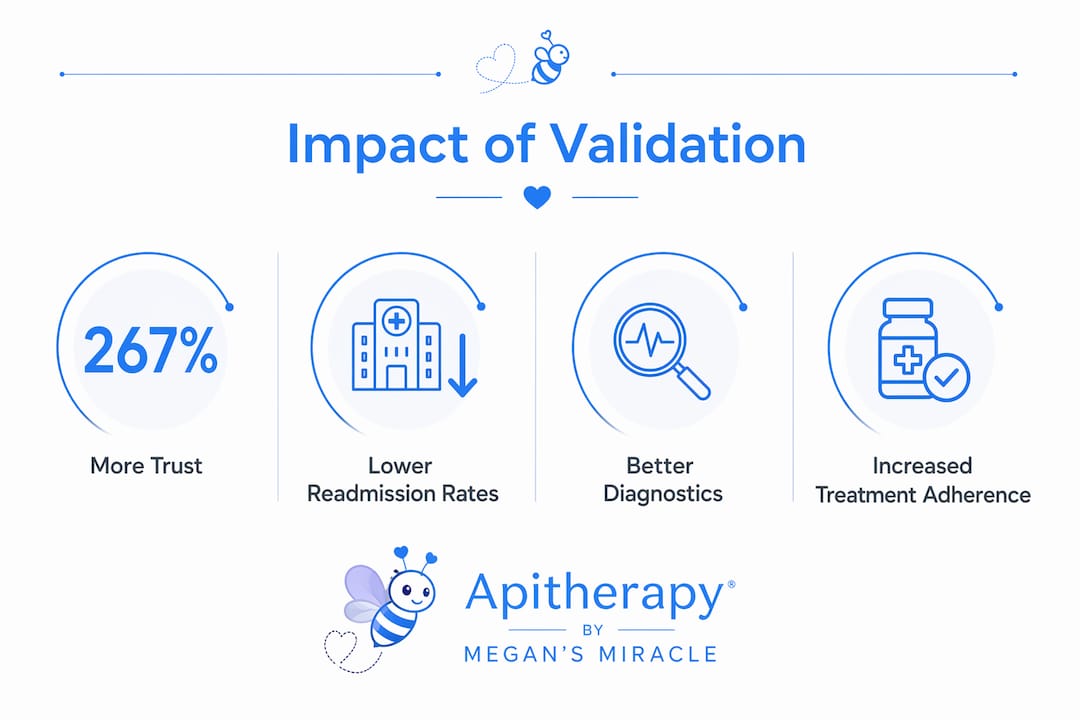
| Outcome Area | Impact of Validated Patient Experience |
|---|---|
| Provider trust | Patients are 267% more likely to trust providers who validate their experience |
| Clinical accuracy | Patient narratives surface diagnostic clues that biomarkers miss |
| Readmission rates | Higher experience scores correlate with lower readmission and safety incidents |
| Treatment adherence | Trust built through validation directly increases adherence to care plans |
How is patient experience validation shifting in regulatory contexts?
The regulatory environment around patient experience data has changed fundamentally. The European Medicines Agency and health technology assessment organizations now require regulatory-grade patient experience data as part of drug approval, reimbursement decisions, and post-marketing safety surveillance. This is not a future trend. It is current practice. Patient experience data has moved from a nice-to-have quality metric to a mandatory evidence standard.
This shift creates a serious methodological challenge. Retrospective self-reporting is prone to recall bias, which compromises data reliability. A patient asked to rate their pain experience from three weeks ago will give you a different answer than one asked in real time. Regulatory-grade data demands real-time, traceable, and minimally burdensome collection methods. This is driving adoption of passive digital monitoring, electronic patient-reported outcomes (ePRO) platforms, and automated check-in systems that capture experience data continuously rather than at a single retrospective point.
For healthcare operations, the practical implications are significant:
- Adopt real-time feedback tools. Replace end-of-stay surveys with continuous digital touchpoints that capture experience as it happens, not weeks later.
- Apply Importance-Performance Analysis (IPA). IPA identifies the gap between what patients value most and how well the system delivers on those priorities. A Swedish healthcare study using IPA found it particularly effective at surfacing disparities for patients with disabilities, a group whose experience is chronically underrepresented in standard surveys.
- Align data collection with regulatory standards. If your organization participates in clinical trials or seeks reimbursement under value-based contracts, your patient experience data collection must meet traceability and reliability requirements.
- Train staff on data integrity. The humans collecting and responding to patient feedback are as important as the tools. A poorly administered survey produces noise, not signal.
Pro Tip: Importance-Performance Analysis is one of the most underused tools in healthcare operations. Run it quarterly, not annually, and segment results by patient population to catch inequities early.
What practical strategies validate patient experiences effectively?
The most powerful reframe in patient experience validation is this: treat patients as expert witnesses, not anecdotal sources. Transitioning patient stories to clinical evidence requires a deliberate shift in how clinicians are trained to receive and document what patients report. A patient describing a symptom pattern that does not fit a standard diagnostic category is not being difficult. They are providing data that the standard categories have not yet accounted for. This is especially true in conditions like Morgellons Disease, where patient narratives have historically been dismissed rather than investigated.
Practical strategies for healthcare professionals and organizations include:
- Combine survey data with narrative comments. Numbers tell you what is happening. Comments tell you why. Both are required for a complete picture. Effective documenting of patient symptoms is a clinical skill that should be taught and standardized.
- Implement nurse leader rounding. Nurse leader rounding promotes trust and improves communication by creating structured, real-time opportunities for patients to raise concerns before they become complaints or adverse events.
- Design culturally competent validation processes. A survey written at a 12th-grade reading level in English only will systematically exclude non-English speakers and low-literacy patients. Inclusive validation requires translated instruments, visual analog scales, and trained interpreters.
- Avoid over-relying on satisfaction scores. A patient who rates their stay a 9 out of 10 but mentions in a comment that they were afraid to ask questions has given you a safety signal. The score masked it. The comment revealed it.
Pro Tip: Build patient advocacy into your clinical workflow. Structured chronic illness advocacy strategies give both patients and clinicians a shared language for surfacing and validating experience data.
How does validation shape healthcare culture and long-term safety?
Validating patient experience is foundational to building a patient-centered culture, and culture is what determines whether clinical excellence is sustainable or situational. Organizations that treat patient feedback as operational intelligence rather than a compliance checkbox develop a fundamentally different relationship with the people they serve. Patients become partners in care rather than passive recipients of it.
The safety implications are direct. Patient narratives frequently surface early warning signals that clinical monitoring misses. A patient who reports feeling “off” in a way they cannot articulate may be describing the early stages of a medication interaction or a deteriorating condition. When that report is validated and documented, it becomes actionable. When it is dismissed, it becomes a near-miss or worse.
Addressing health equity requires targeted validation efforts. Standard HCAHPS surveys systematically underrepresent patients with disabilities, non-English speakers, and patients from low-income backgrounds. Importance-Performance Analysis applied to these subgroups reveals gaps that aggregate scores hide. Closing those gaps is not just an equity issue. It is a quality issue, because underserved populations often carry the highest burden of complex, undertreated conditions.
Long-term patient engagement also depends on validation. Patients who feel heard return for follow-up care, comply with preventive screening, and report symptoms earlier. Those who feel dismissed disengage, delay care, and present later with more advanced disease. The impact of patient experience on long-term health outcomes is cumulative and significant.
Key takeaways
Validating patient experience is a clinical imperative that directly improves trust, diagnostic accuracy, treatment adherence, and safety outcomes across every healthcare setting.
| Point | Details |
|---|---|
| Validation builds trust | Patients who feel heard are 267% more likely to trust their provider and follow treatment plans. |
| Experience differs from satisfaction | Patient experience captures objective care events; satisfaction captures subjective feelings. Both must be measured. |
| Regulatory standards are rising | EMA and HTA bodies now require real-time, traceable patient experience data for approval and reimbursement. |
| Narratives are clinical evidence | Patient stories surface diagnostic clues that biomarkers and standard tests cannot detect. |
| Equity requires targeted methods | Importance-Performance Analysis applied to underserved groups reveals quality gaps that aggregate scores mask. |
What I’ve learned from living on the wrong side of dismissal
I want to be honest with you about something. The research in this article is solid, and the regulatory shifts are real. But none of it captures what it actually feels like to sit in a doctor’s office and watch your account of your own body get quietly filed away as “patient anxiety.” I have been there. Many people in the Morgellons and Lyme communities have been there, over and over, for years.
What I have come to understand is that the gap between what patients experience and what providers document is not always about bad intentions. It is about a system that was not designed to treat patient narratives as evidence. Changing that requires more than better surveys. It requires a genuine shift in how clinicians are trained to listen.
The most transformative moments I have witnessed in healthcare happen when a provider stops performing clinical authority and starts practicing clinical curiosity. When they ask, “Tell me more about that,” and actually wait for the answer. That is validation. It costs nothing and changes everything.
Healthcare professionals and researchers reading this: your patients are not exaggerating. They are not seeking attention. They are trying to give you the data you need to help them. The framework for treating their stories as evidence already exists. The question is whether your organization has the will to use it.
— Megan
How Megansmiraclestudio supports patient wellness alongside validated care
At Megansmiraclestudio, we built this platform because we know what it means to have your experience dismissed and your symptoms go untreated. Every product we offer is designed to support the body while you fight for the care you deserve. Our supplements and internal detox collection supports immune function and systemic wellness for people managing complex chronic conditions like Morgellons Disease and Lyme disease. We also offer apitherapy resources, including information on honeybee venom therapy, for those exploring natural treatment modalities alongside conventional care. You are not alone in this, and you deserve both validation and real support.
FAQ
What does validating patient experience mean in clinical practice?
Validating patient experience means treating patient narratives as credible clinical evidence rather than subjective complaints. It involves structured documentation, active listening, and integrating patient-reported data into diagnostic and treatment decisions.
How is patient experience different from patient satisfaction?
Patient experience captures objective, observable care events such as whether medications were explained clearly. Patient satisfaction reflects a subjective emotional response to care, which can be high even when clinical quality is poor.
Why does patient experience data matter for regulatory approval?
The European Medicines Agency and health technology assessment organizations now require regulatory-grade patient experience data for drug approval and reimbursement. This data must be real-time, traceable, and collected with minimal burden on patients.
What is the most effective way to collect patient experience data?
Combining structured instruments like HCAHPS with open-text qualitative comments and real-time digital feedback tools produces the most complete picture of care quality. Retrospective surveys alone are prone to recall bias and miss critical nuance.
How does validating patient experience improve safety outcomes?
Patient narratives frequently surface early warning signals that clinical monitoring misses. When those reports are validated and documented, they become actionable safety data. When dismissed, they become missed opportunities to prevent adverse events.