

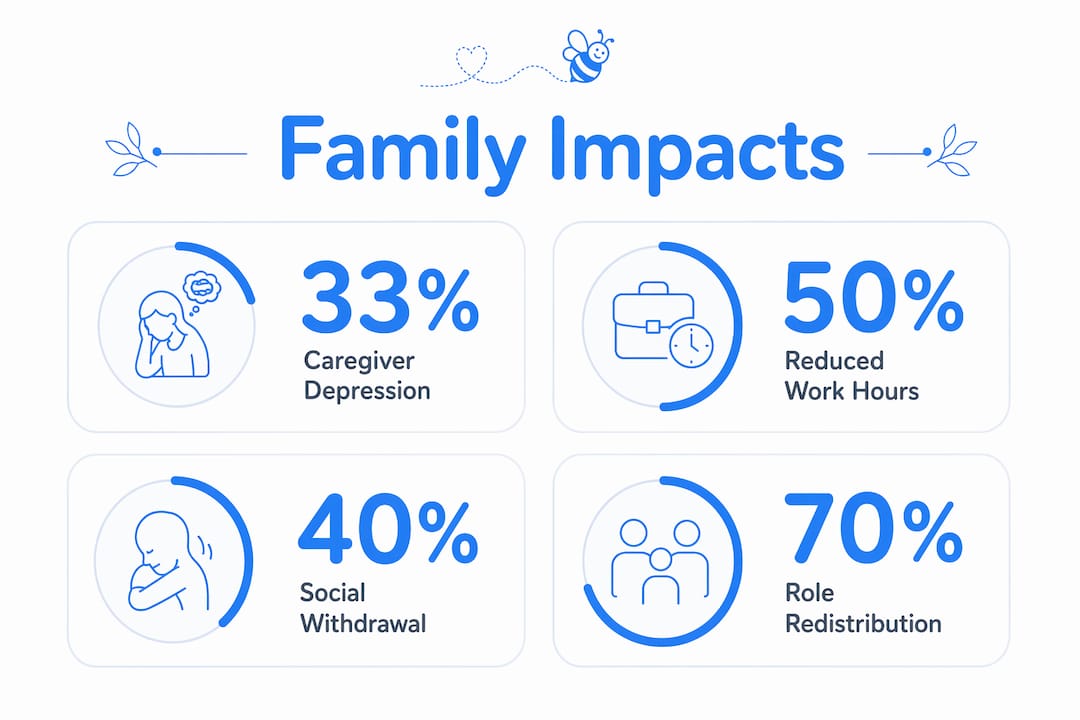
Chronic illness reshapes every relationship inside a family, not just the life of the person who is sick. How chronic illness affects family dynamics is a process that touches roles, communication, emotional health, and daily routines for every family member. Research using the Family Adjustment and Adaptation Response (FAAR) model shows families move through distinct phases of disruption and reorganization. Nearly 1 in 3 caregivers report depression or anxiety, and close to half experience significant caregiver burden. Understanding these patterns is the first step toward doing something real about them.
How does chronic illness affect family dynamics and roles?
Chronic illness forces an immediate redistribution of responsibilities inside the home. Tasks the ill family member once handled, from driving children to school to managing finances, shift to others, often permanently. This redistribution is not always discussed openly. It simply happens, and resentment can build quietly underneath the surface.

Role reversal is one of the most painful shifts families face. Adult children take on parenting functions for a sick parent. Spouses absorb both their own role and their partner’s. Teenagers step into adult caregiver positions before they are ready. Chronic illness limits independence in six documented ways: reduced personal independence, compromised marital relations, parenting limitations, increased financial strain, restricted social activities, and psychological discomfort. Each of these ripples outward and lands on the people closest to the patient.
Parenting roles suffer in ways that rarely get named. A sick parent may feel profound guilt about what they cannot give their children. The well parent compensates by overextending. Children learn to suppress their own needs to avoid adding to the household stress. These patterns, left unaddressed, can define a child’s emotional development for years.
- Caregiver role absorption: One family member, often a spouse or eldest child, takes on the majority of care tasks without formal acknowledgment or support.
- Financial role shifts: The ill member may lose income, forcing another family member into longer work hours or a second job.
- Parenting role compression: The well parent handles discipline, emotional support, logistics, and household management simultaneously.
- Social role withdrawal: The family unit pulls back from community activities, friendships, and extended family events due to time and energy constraints.
Pro Tip: Name the role shifts out loud. Sit down as a family and list who is doing what now versus before the illness. Naming the change reduces silent resentment and opens the door to fair negotiation.
If you want practical guidance on advocating within your care system, Megansmiraclestudio has resources written specifically for families in this position.
How does chronic illness affect communication and emotional dynamics?
Communication inside a family living with chronic illness changes in ways that feel invisible until they cause a crisis. Family members often suppress their own distress to protect the person who is sick. This pattern is called emotional co-regulation, and it is more dangerous than it sounds.
Emotional co-regulation provides short-term cohesion but predicts caregiver burnout and family crisis without intervention. The family holds together on the surface while pressure builds underneath. Nobody talks about fear. Nobody admits exhaustion. Everyone performs “fine” for each other, and the cost accumulates silently.
Anticipatory anxiety is another communication killer. Family members worry constantly about the next flare, the next hospital visit, the next piece of bad news. That anxiety leaks into every conversation, making ordinary discussions feel loaded. The ill family member often senses this and withdraws to avoid being a burden, which deepens isolation for everyone.
Effective communication in these families requires deliberate new norms. Research shows that consent-based communication preserves the patient’s sense of identity and emotional connection. Asking “Is now a good time to talk about how you’re feeling?” before launching into a symptom check respects the patient’s autonomy and reduces the feeling of being defined entirely by their illness.
Here are four communication practices that actually work:
- Schedule a weekly family check-in. Keep it short, 15 to 20 minutes. Give every person a turn to speak without interruption.
- Separate illness talk from relationship talk. Designate specific times for medical updates so that every conversation does not become a symptom report.
- Use “I” statements for emotional expression. “I feel scared when you don’t answer my calls” lands differently than “You scared me.”
- Share small pieces of your own life. Supporters who share their own experiences rather than interrogating the patient about symptoms protect the patient’s sense of identity.
“Predictable rhythms and scheduled check-ins create a safe environment for the patient, promoting stability in family dynamics without causing anxiety.”
Pro Tip: If a family member shuts down during illness conversations, try a written check-in instead. A shared notebook or a simple text thread can lower the emotional stakes enough to get real communication flowing.
What psychological and social impacts does chronic illness have on family members?
The mental health consequences of living with chronic illness spread across the entire family system, not just the patient. Approximately 33% of caregivers report depression or anxiety, and nearly 50% experience significant caregiver burden. That burden does not stay contained to the caregiver. It spreads stress throughout the household.
Illness severity is the strongest predictor of family caregiver stress. The more severe and unpredictable the condition, the higher the psychological toll on everyone around the patient. Social support is the single most effective buffer against that stress. Families with strong support networks cope measurably better than those who try to manage alone.
| Impact area | Effect on family members |
|---|---|
| Mental health | Depression and anxiety in up to 1 in 3 caregivers |
| Social life | Withdrawal from friendships, community events, and leisure activities |
| Financial health | Lost income, increased medical costs, and reduced career opportunities |
| Parenting quality | Reduced emotional availability and increased household tension |
| Relationship satisfaction | Marital strain from role overload and reduced intimacy |
Financial strain deserves direct attention. Medical costs accumulate fast. One family member may reduce work hours to provide care. Another may delay career advancement. These financial pressures feed anxiety, which feeds relationship conflict, which feeds caregiver burnout. The cycle is real and it is brutal.
Social withdrawal compounds everything. Families managing chronic illness often pull back from support communities at exactly the moment they need them most. Shame, exhaustion, and logistical barriers all contribute. Isolation accelerates psychological distress for every family member.
Understanding why caregiver education matters is one of the most practical steps a family can take. Educated caregivers recognize burnout earlier and seek help before crisis hits.
How do families adapt and cope with chronic illness over time?
The FAAR model, developed by family stress researchers, describes two distinct phases families move through when chronic illness enters the picture. The first is the adjustment phase, where the family uses existing resources and routines to manage the new demands. The second is the adaptation phase, where the family recognizes that old patterns no longer work and builds new ones.
The problem is that families often fail to recognize when they have moved from adjustment into adaptation. They keep applying old coping strategies to a fundamentally changed situation and wonder why nothing improves. Recognizing this transition is not automatic. It requires someone in the family, or a counselor, to name it directly.
Meaning-making under ambiguity is one of the most powerful adaptive tools available. Families that find purpose and structure in daily life, even when the illness trajectory is uncertain, report better functioning and lower psychological distress. This does not mean pretending everything is fine. It means building small rituals, shared goals, and moments of connection that exist independent of the illness.
Practical adaptive strategies that research supports:
- Scheduled respite for caregivers. Vague offers of help are insufficient. Caregivers need specific, scheduled time off. “I’ll take over every Saturday morning” works. “Let me know if you need anything” does not.
- Structured check-ins. Predictable family rhythms reduce anxiety and give every family member a safe container for their feelings.
- Connecting with support networks. Peer support groups, online communities, and professional counseling all reduce isolation and provide practical coping knowledge.
- Separating identity from illness. Families that maintain activities, humor, and relationships beyond the illness report stronger emotional bonds and lower rates of caregiver burnout.
Pro Tip: Ask your family this question once a month: “Are we still using the same coping strategies we used at the beginning?” If the answer is yes and things are not improving, you have likely moved into the adaptation phase without realizing it.
Key Takeaways
Chronic illness reshapes every layer of family life, and families that name the changes, build new communication norms, and seek specific support cope significantly better than those who try to absorb the pressure silently.
| Point | Details |
|---|---|
| Role redistribution is inevitable | Name the new roles openly to prevent silent resentment from building. |
| Emotional co-regulation is a hidden risk | Suppressing distress to protect each other predicts caregiver burnout without intervention. |
| Caregiver mental health is a family issue | Nearly 1 in 3 caregivers develop depression or anxiety, spreading stress to the whole household. |
| Specific support beats vague offers | “I’ll handle dinner Thursday” reduces caregiver burden far more than “let me know if you need help.” |
| Recognizing the FAAR adaptation phase matters | Families stuck in adjustment-phase patterns need to consciously build new coping behaviors. |
What I’ve learned about families and chronic illness that most articles miss
I have watched chronic illness tear families apart, and I have watched it pull them closer than they ever were before. The difference almost always comes down to one thing: whether the family is willing to talk about what is actually happening, not just the medical facts, but the fear, the grief, the anger, and the love underneath all of it.
The thing that breaks my heart is how many caregivers I see running themselves into the ground while refusing to ask for help. They think asking for help means they are failing. They are not failing. They are human. The research is clear: proactive, specific support reduces caregiver burden. But someone has to offer it specifically, and the caregiver has to be willing to accept it.
The other thing I want to say directly is this: the person who is sick is not just a patient. They are still a parent, a partner, a friend, a person with opinions and humor and dreams. Families that keep connecting with that person, beyond the illness, beyond the symptoms, beyond the medical appointments, are the ones that survive this with their relationships intact. Do not let the illness become the only thing you talk about. Do not let it become the only thing you see.
If you are in the thick of this right now, please know that the chaos you feel is not a sign that you are doing it wrong. It is a sign that you are living through something genuinely hard. Give yourself and your family some grace. And then get specific about what you need.
— Megan
Natural support for families living with chronic illness
Living with a chronic condition is exhausting for everyone in the household. When the body is fighting every day, the last thing you need is a wellness routine that adds more complexity to your life.
At Megansmiraclestudio, the focus is on natural approaches that work alongside your existing care plan. The supplements and internal detox collection includes products designed to support immune function and reduce the internal burden that chronic conditions create. For families dealing with conditions like Morgellons or Lyme disease, the medical-grade bee venom therapy kit offers an apitherapy option grounded in natural anti-inflammatory properties. Every product comes with educational resources so you understand exactly what you are using and why.
FAQ
How does chronic illness change family roles?
Chronic illness redistributes tasks and responsibilities across the family, often permanently. One or more family members absorb the ill person’s previous duties, which can create caregiver burden, role reversal, and unspoken resentment if not addressed openly.
What mental health effects do caregivers face?
Nearly 1 in 3 caregivers of chronically ill individuals report depression or anxiety, and close to half experience significant caregiver burden. Illness severity is the strongest predictor of that stress.
What is the FAAR model and why does it matter for families?
The Family Adjustment and Adaptation Response (FAAR) model describes two phases families move through: an initial adjustment phase using existing resources, followed by an adaptation phase requiring new roles and behaviors. Recognizing the transition between phases helps families stop applying outdated coping strategies.
How can families communicate better when one member is chronically ill?
Scheduled check-ins, consent-based conversations, and separating illness talk from relationship talk all improve communication. Supporters should also share parts of their own lives rather than focusing every conversation on symptoms.
What is the most effective form of support for a caregiver?
Specific, proactive offers of help reduce caregiver burden far more effectively than open-ended offers like “let me know what you need.” Scheduled respite and concrete task assistance are the most protective against burnout.