
A holistic health approach is defined as a method of care that treats the entire person — body, mind, emotions, social connections, and spirit — rather than targeting isolated symptoms. If you’ve been living with a chronic condition like Morgellons Disease or Lyme disease, you already know that treating just one symptom at a time feels like putting a bandage on a wound that keeps reopening. The Merck Manual defines integrative medicine as combining conventional and nonconventional therapies to restore balance across the whole person. That is the heart of what holistic health means. It is not a trend. It is a structured, patient-centered framework that the World Health Organization and leading medical references now recognize as a legitimate path to lasting wellness.
What is a holistic health approach and how does it work?
Holistic health is built on one foundational truth: your physical symptoms do not exist in isolation. They are shaped by your mental state, your emotional history, your relationships, and even your sense of purpose. The holistic care model addresses physical, mental, emotional, social, and spiritual factors as a dynamic, interconnected system rather than separate boxes to check.

This is where the holistic health definition diverges sharply from conventional symptom management. A standard medical visit might address your rash, your fatigue, or your pain. A holistic approach asks why those symptoms exist, what is driving them at the root, and what needs to shift across multiple dimensions of your life to create real change. That shift in framing changes everything about how care is designed and delivered.
The therapeutic relationship is central to this model. You are not a passive recipient of treatment. You are an active participant in a care plan built around your full picture. That is not just a philosophical stance. It is a structural requirement of effective whole-person care.
How does holistic health integrate with conventional medicine?
The relationship between holistic health and conventional medicine is not adversarial. It is integrative. The Merck Manual describes integrative medicine as using all appropriate therapeutic approaches within a framework focused on the whole person and the therapeutic relationship. That means your prescription medications, your acupuncture sessions, your nutrition plan, and your meditation practice can all belong to the same coordinated care strategy.
The World Health Organization has formalized this integration through its Global Traditional Medicine Strategy 2025 to 2034, adopted by the World Health Assembly. The strategy focuses on universal access to safe, evidence-based traditional and complementary medicine. This is not fringe thinking anymore. This is global health policy.
WHO identifies four distinct integration models for organizing holistic care within health systems:
- People-led integration: Individuals self-select and combine therapies based on personal values and access.
- Practitioner-led integration: A single qualified practitioner coordinates multiple modalities for one patient.
- Coordinated integration: Multiple practitioners from different disciplines communicate and align on a shared care plan.
- Blended integration: Conventional and complementary approaches are formally merged within a single health system or clinic.
Each model has real-world applications. For someone managing a complex chronic condition, the coordinated or blended models tend to produce the most consistent outcomes because they reduce the risk of conflicting treatments or gaps in care.
One critical distinction: adding a supplement to your routine is not holistic health. Effective holistic programs require a clinician relationship and an overall care plan. Without that structure, you are just layering interventions without a map.
Pro Tip: Before adding any complementary therapy, ask your primary care provider to review it against your current treatments. This one conversation can prevent dangerous interactions and turn isolated practices into a real integrated plan.
What are the common types of holistic wellness practices?
Holistic wellness practices fall into four broad categories recognized by the Merck Manual and used across integrative health programs worldwide.
- Whole medical systems: Complete frameworks like Traditional Chinese Medicine, Ayurveda, and naturopathic medicine that carry their own diagnostic and treatment logic.
- Mind-body medicine: Practices that use behavioral, psychological, social, and spiritual techniques to regulate physical health. Mind-body techniques include meditation, yoga, biofeedback, and guided imagery.
- Manipulative and body-based practices: Chiropractic care, massage therapy, and craniosacral therapy work through physical manipulation of body structures.
- Energy medicine: Modalities like acupuncture, Reiki, and apitherapy that work with the body’s energy systems or bioactive compounds.
The table below compares common holistic modalities by their primary focus area and the type of condition they most often address.
| Modality | Primary focus | Common applications |
|---|---|---|
| Meditation and mindfulness | Mental and emotional regulation | Stress, anxiety, chronic pain |
| Yoga | Physical and mental integration | Flexibility, mood, nervous system balance |
| Acupuncture | Energy flow and pain pathways | Chronic pain, inflammation, fatigue |
| Apitherapy (bee venom) | Immune modulation and inflammation | Lyme disease, Morgellons, autoimmune conditions |
| Snow mushroom therapy | Immune support and cellular health | Chronic illness recovery, skin health |
| Nutritional therapy | Biochemical and gut health | Inflammation, energy, disease prevention |
Mind-body connections are not abstract. When you are living in fear, grief, or chronic stress, your immune system responds. Your inflammation markers rise. Your gut microbiome shifts. Holistic wellness practices work precisely because they address those feedback loops directly, not just the downstream symptoms they produce. You can explore how meridian pathways map these connections with a meridian body guide that visualizes the energy systems underlying many of these practices.
What are the measurable benefits of holistic health?
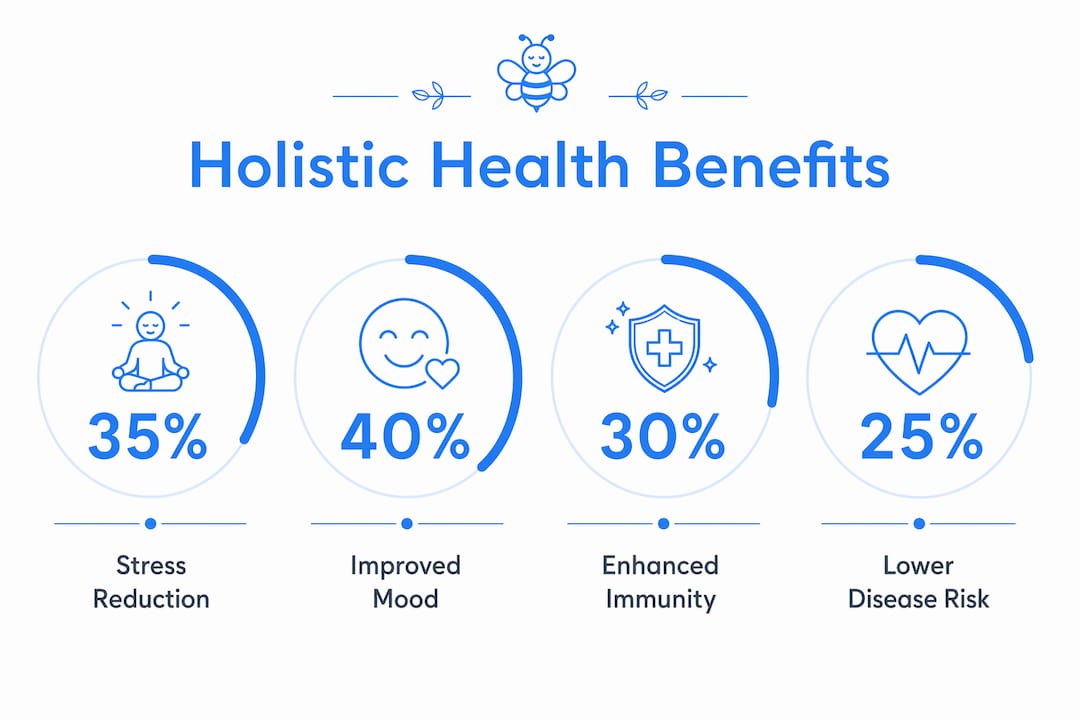
The benefits of holistic health are not vague or anecdotal. Research documents specific measurable outcomes including decreased stress, lower disease risk, enhanced resilience, improved mood, and better overall quality of life. These outcomes come from prevention-focused strategies that require your active participation. That last part matters. Holistic health gives you agency in your own recovery.
“Holistic care focuses on root causes beyond symptom management and promotes lifestyle and emotional balance.” — Preventive Medicine Daily
Root-cause focus is what separates this model from conventional symptom management. When you treat only the rash, the rash may return. When you treat the immune dysregulation, the chronic inflammation, the emotional burden, and the nutritional deficiencies driving the rash, you create conditions where healing becomes possible at a deeper level.
For people living with Morgellons Disease or Lyme disease, this distinction is not academic. It is the difference between years of suffering and a path toward actual recovery. Holistic health also improves energy and lifestyle balance by addressing sleep, nutrition, movement, and stress simultaneously rather than sequentially. The compounding effect of addressing multiple dimensions at once accelerates outcomes that single-modality approaches rarely achieve.
Patient empowerment is another measurable benefit. When you understand your care plan, participate in designing it, and see how each element connects to the others, your adherence improves. Your outcomes improve. You stop feeling like a passive victim of your condition and start feeling like someone actively fighting for your own health.
How to safely adopt holistic health practices in daily life
Safety is not optional in holistic health. It is the foundation. The WHO strategy explicitly emphasizes safety, regulation, and evidence strengthening as core objectives for responsible practice. Uncoordinated or unregulated approaches carry real risks, including dangerous interactions between natural therapies and pharmaceutical medications.
Here is how to build a safe, effective holistic health practice:
- Start with a qualified practitioner. Look for credentials in integrative medicine, naturopathic medicine, or functional medicine. Organizations like the Functional Medicine Academy provide resources for understanding what legitimate holistic practice looks like.
- Build a coordinated care plan. Do not run parallel tracks without communication between your providers. Coordinated integration, as defined by WHO, produces better outcomes than isolated interventions.
- Prioritize evidence-informed therapies. Not every natural therapy has the same evidence base. Prioritize modalities with documented research, and be honest with yourself about the difference between hope and evidence.
- Track your responses. Keep a symptom journal. Note what shifts, what worsens, and what stays the same. This data makes your care plan smarter over time.
- Address lifestyle foundations first. Sleep hygiene, whole-food nutrition, daily movement, and stress reduction are not optional add-ons. They are the platform everything else builds on.
For those navigating complex chronic conditions, structured recovery protocols can provide a starting point. The Stage 1 recovery protocol at Megansmiraclestudio outlines a sequenced approach that integrates multiple natural therapies with clear guidance on application and safety.
Pro Tip: When evaluating any new holistic therapy, ask three questions: Is there published research on this? Is the practitioner credentialed? Does this fit within my overall care plan? If you cannot answer yes to at least two of those three, slow down.
Key takeaways
A holistic health approach works because it addresses the root causes of illness across physical, mental, emotional, social, and spiritual dimensions simultaneously, within a structured, coordinated care framework.
| Point | Details |
|---|---|
| Whole-person definition | Holistic health treats all dimensions of a person, not just physical symptoms. |
| Integration with conventional care | Effective holistic programs require a care plan and clinician relationship, not just added supplements. |
| WHO-recognized frameworks | Four integration models (people-led, practitioner-led, coordinated, blended) guide real-world application. |
| Measurable benefits | Documented outcomes include reduced stress, lower disease risk, improved mood, and better quality of life. |
| Safety is non-negotiable | WHO strategy requires evidence, regulation, and coordination to avoid unsafe or unregulated practices. |
What I’ve learned about holistic health after years of fighting chronic illness
Here is something most articles on holistic health will not tell you: the word “holistic” has been so diluted by wellness marketing that it has almost lost its meaning. I have seen people spend thousands of dollars on supplements, crystals, and detox programs with zero coordination, zero practitioner oversight, and zero improvement. That is not holistic health. That is desperation dressed up as wellness.
Real holistic health is harder than that. It requires you to look at your whole life, not just your symptoms. It requires you to build relationships with practitioners who actually listen. It requires patience, because root causes do not resolve overnight. When I was in the worst of my own health nightmare, I wanted a single answer. There was not one. There never is.
What actually moved the needle was building a structured plan that addressed my immune system, my nervous system, my nutrition, and my emotional state at the same time. Not sequentially. Simultaneously. That is what the WHO frameworks and the Merck Manual are describing when they talk about coordinated, whole-person care. It is not soft. It is rigorous.
The other thing I want you to hear: holistic does not mean unregulated. The practitioners and protocols worth trusting are the ones who lead with safety, demand evidence, and communicate with your other providers. Anyone who tells you to abandon conventional medicine entirely is not offering you holistic care. They are offering you a different kind of tunnel vision.
— Megan
Natural therapies that support your holistic wellness journey
At Megansmiraclestudio, every product we carry exists because it earned its place in a real recovery protocol. Our Snow Mushroom Polysaccharide Capsules support immune function and cellular health, making them a natural fit for anyone building a nutrition-based foundation for holistic wellness. For those exploring apitherapy as part of an integrative care plan, our Natural Grade Bee Venom Therapy Kit provides a structured, accessible entry point into one of the most researched natural immune-modulating therapies available. These are not quick fixes. They are tools for people who are serious about healing from the inside out.
FAQ
What does holistic health mean in simple terms?
Holistic health means treating the whole person, including physical, mental, emotional, social, and spiritual dimensions, rather than just managing individual symptoms. It focuses on root causes and active patient participation in care.
Is holistic health the same as alternative medicine?
No. Holistic health is a broader framework that can include conventional medicine alongside complementary therapies. The Merck Manual defines integrative medicine as combining both within a structured, whole-person care plan.
What are the main benefits of holistic health?
Documented benefits include decreased stress, lower disease risk, enhanced resilience, improved mood, and better overall quality of life. These outcomes result from prevention-focused strategies that address multiple health dimensions simultaneously.
How do I start adopting holistic health practices safely?
Start by consulting a qualified integrative or naturopathic practitioner, build a coordinated care plan, and prioritize evidence-informed therapies. The WHO recommends safety, regulation, and evidence as the foundation of any responsible holistic health practice.
Can holistic health help with chronic conditions like Lyme disease or Morgellons?
Yes. Holistic approaches are particularly relevant for complex chronic conditions because they address the immune, neurological, nutritional, and emotional dimensions that conventional symptom management often misses. Structured protocols that integrate natural therapies with conventional care tend to produce the most consistent results.