
Holistic chronic disease prevention strategies are defined as the coordinated integration of diet, physical activity, sleep, stress management, social health, and complementary therapies to reduce disease risk across a person’s entire lifespan. In lifestyle medicine, this approach is called multimodal prevention, and it treats the body as a system rather than a collection of separate problems. A 2025 expert consensus confirms that sustainable, lifelong behavior change combining healthy eating and active living produces synergistic benefits no single intervention can match. If you are living with a chronic condition or fighting to stay ahead of one, this guide covers what the science actually says, what works in real life, and how to build a plan that holds.
What are the fundamental lifestyle components for preventing chronic disease?
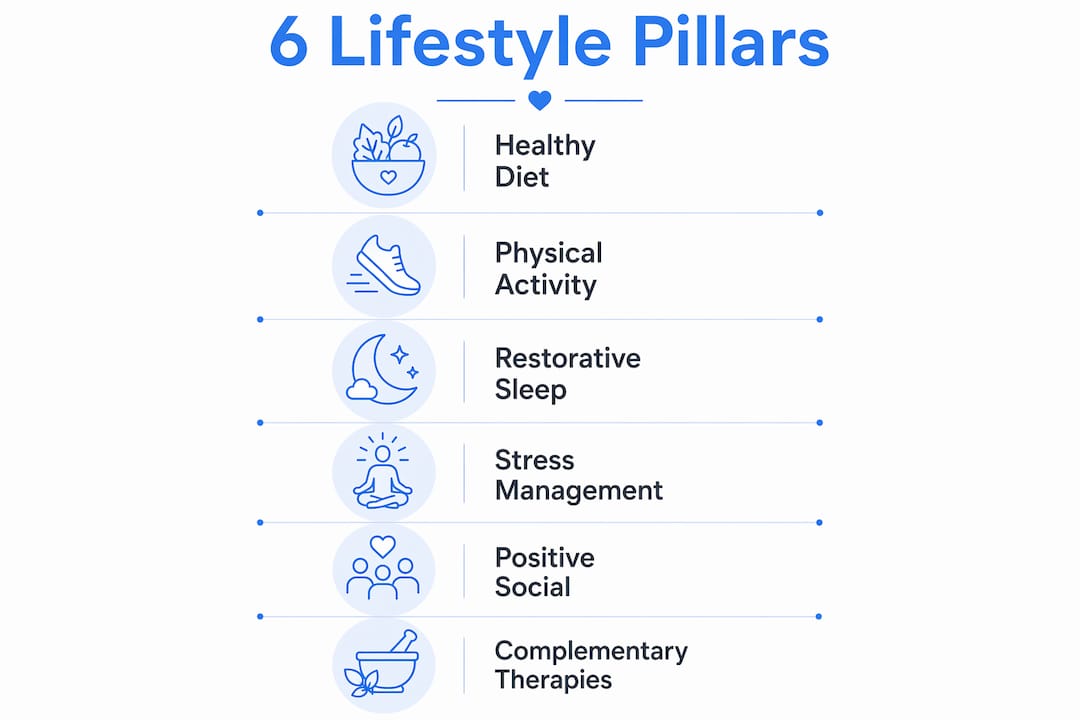
The six pillars of lifestyle medicine are diet, physical activity, restorative sleep, stress management, positive social connections, and avoidance of risky substances. These are not six separate to-do items. They are interconnected lifestyle behaviors that amplify each other when practiced together. Improving sleep makes stress easier to manage. Managing stress makes better food choices feel less like a fight. That compounding effect is the whole point.

Diet and physical activity as the foundation
The U.S. National Institute of Diabetes and Digestive and Kidney Diseases recommends keeping added sugars under 10% of daily calories, saturated fat under 10%, and sodium under 2,300 mg per day, alongside at least 150 minutes per week of moderate aerobic activity. Those numbers are not arbitrary. They represent the threshold below which cardiometabolic risk drops meaningfully for most adults. Pair that activity with muscle-strengthening work at least twice a week, and you are covering both metabolic and structural health.
Sleep and stress as behavior amplifiers
A 2026 network meta-analysis found that combined aerobic and resistance training is superior to either alone for improving sleep quality, with 60 to 70 cumulative exercise hours representing the optimal dose window. Beyond that point, returns diminish and adherence often drops. That finding matters because most prevention programs push volume without acknowledging that more is not always better.
Mindfulness and meditation deserve a realistic assessment. A 2026 systematic review of 132 randomized controlled trial groups covering 23,080 participants found effect sizes of g = 0.51 for perceived stress reduction and g = 0.38 for anxiety, with most benefits sustained within three months. Those are meaningful numbers for mental health. The evidence for direct cardiometabolic improvement through meditation alone is weaker, which means mindfulness works best as a support layer, not a standalone fix.
- Dietary quality: Prioritize whole foods, fiber, and plant-predominant meals over supplement-first thinking.
- Movement: Combine aerobic and resistance training rather than relying on one type alone.
- Sleep: Target seven to nine hours per night and treat sleep disruption as a medical issue, not a lifestyle inconvenience.
- Stress management: Use mindfulness, breathwork, or evidence-based strategies as daily practices, not crisis responses.
- Social health: Positive relationships reduce inflammatory markers. Isolation is a documented chronic disease risk factor.
- Substance avoidance: Tobacco and excessive alcohol undermine every other pillar you build.
Pro Tip: Stack behaviors deliberately. Add a five-minute breathing practice immediately after your morning walk. Pairing a new habit with an existing one dramatically increases the chance it sticks.
How do evidence-based dietary patterns reduce chronic disease risk?
The Mediterranean diet, DASH diet, and Alternative Healthy Eating Index are the three most studied dietary patterns in chronic disease prevention, and the data behind them is hard to argue with. A 2025 meta-analysis of randomized controlled trials found that Mediterranean dietary patterns reduce HbA1c by 0.307%, fasting plasma glucose by 0.845 mmol/L, and BMI by 0.828 kg/m2 in adults with type 2 diabetes compared to control groups. Those reductions are clinically meaningful, not just statistically significant.
A separate 2025 dose-response meta-analysis covering 11 cohorts and over 450,000 participants found that higher adherence to DASH, Mediterranean, or Alternative Healthy Eating Index patterns is associated with roughly a 25% lower risk of heart failure. That is a hazard ratio in the range of 0.74 to 0.81. Put simply, what you eat consistently over years shapes your cardiovascular future more than almost any other single factor.
| Dietary pattern | Primary benefit | Key foods emphasized |
|---|---|---|
| Mediterranean | Glycemic control, BMI reduction, heart health | Olive oil, fish, legumes, vegetables, whole grains |
| DASH | Blood pressure reduction, heart failure risk | Low-sodium foods, fruits, vegetables, low-fat dairy |
| Plant-predominant | Metabolic and inflammatory markers | Vegetables, legumes, nuts, seeds, minimal processed foods |
| Alternative Healthy Eating Index | Broad cardiometabolic protection | Whole grains, nuts, long-chain fats, low red meat |
The practical challenge is not knowing which diet is best. It is making any of them work inside your actual life. Cultural food traditions, food access, and budget all shape what is realistic. The Mediterranean pattern, for example, is highly adaptable. Swapping refined grains for whole grains, adding a handful of walnuts, and cooking with olive oil instead of butter gets you most of the benefit without overhauling everything at once.
Whole foods consistently outperform supplements in the research. Micronutrients from food come packaged with fiber, phytonutrients, and cofactors that isolated supplements cannot replicate. Reach for the food first.
Pro Tip: If cost is a barrier, canned legumes, frozen vegetables, and sardines deliver Mediterranean-pattern nutrition at a fraction of the price of fresh fish and specialty produce. The pattern matters more than the premium ingredients.
What role do complementary therapies play in chronic disease prevention?
Complementary therapies, including acupuncture, massage, herbal medicine, and apitherapy, are not replacements for lifestyle medicine. They are adjunctive tools that can support the body’s regulatory systems when used alongside foundational lifestyle changes. The distinction matters enormously, because using them in isolation without addressing diet, sleep, and stress is like patching a leak without fixing the pipe.
The WHO’s 2025 framework for integrating traditional and complementary medicine into health systems emphasizes governance, coordination, and standardized information systems as the conditions that make these therapies safe and effective. Without that structure, the risks of medication interactions, inconsistent quality, and misuse rise sharply. That is not a reason to avoid complementary therapies. It is a reason to use them with professional guidance.
Apitherapy, which uses bee-derived products including venom, propolis, and honey, has a long history in natural medicine and is gaining renewed research attention for its anti-inflammatory and immunomodulatory properties. For people managing complex chronic conditions like Lyme disease or Morgellons, where conventional medicine often falls short, apitherapy represents one of the more studied natural adjuncts available. Megansmiraclestudio has built its entire platform around this approach, offering medical-grade bee venom kits and snow mushroom polysaccharide therapies for exactly this population.
Safety and coordination are non-negotiable. Before adding any complementary therapy to your routine, read about communicating with your doctor about alternative treatments. Medication interactions, contraindications, and dosing all require professional oversight, especially if you are managing metabolic conditions or taking prescription drugs.
- Acupuncture has documented effects on pain modulation and stress response.
- Massage therapy supports parasympathetic nervous system activation, which directly counters chronic stress physiology.
- Apitherapy products, when standardized and professionally guided, offer anti-inflammatory support that complements dietary and lifestyle interventions.
- Herbal and mushroom-based therapies, including snow mushroom polysaccharides, show immunomodulatory activity in early research.
How can you implement and sustain these strategies in daily life?
Knowing what to do and actually doing it are two completely different problems. Most people fail at prevention not because they lack information but because they try to change everything at once, burn out in three weeks, and conclude that they are just not the type of person who can do this. That story is not true. It is just a sequencing problem.
Here is a practical sequence that works:
- Start with one dietary shift. Replace one processed food item per week with a whole food alternative. Do not overhaul your pantry on day one.
- Add movement in a form you actually enjoy. Walking, swimming, cycling, and resistance bands all count. The best exercise is the one you will repeat.
- Protect sleep before adding anything else. A consistent sleep and wake time, even on weekends, is the single highest-leverage sleep intervention available without medication.
- Layer in stress management after two to four weeks. A five-minute morning breathing practice or a guided meditation app like Insight Timer or Calm builds the habit without overwhelming your schedule.
- Audit your social environment. Identify one relationship that supports your health goals and invest in it deliberately.
- Introduce complementary therapies with professional input. Do not self-prescribe. Work with a practitioner who understands your full health picture.
Tracking matters. Apps like Cronometer for nutrition, Garmin Connect for activity, and a simple sleep log give you data to work with instead of guesses. Setbacks are not failures. They are information. If a strategy is not sticking after four weeks, the problem is the strategy, not your willpower.
“The goal is not perfection. The goal is a lifestyle that is better than last year’s, built one honest decision at a time.”
Pro Tip: Use behavioral health strategies that focus on identity-based change rather than outcome-based goals. Saying “I am someone who moves every day” is more durable than “I want to lose 20 pounds.”
If you are managing a complex chronic condition, patient advocacy resources can help you navigate the healthcare system while pursuing a natural prevention plan alongside conventional care.
Key takeaways
Effective chronic disease prevention requires integrating diet, physical activity, sleep, stress management, and complementary therapies as a unified system, not a checklist of isolated habits.
| Point | Details |
|---|---|
| Integration beats isolation | Combining diet, activity, sleep, and stress management produces synergistic benefits no single intervention can match. |
| Dietary patterns have strong evidence | Mediterranean and DASH patterns reduce heart failure risk by roughly 25% and improve glycemic control meaningfully. |
| Exercise dose has an optimal window | 60 to 70 cumulative hours of combined aerobic and resistance training optimizes sleep and weight outcomes without diminishing returns. |
| Complementary therapies need coordination | Apitherapy, acupuncture, and herbal therapies are safest and most effective when integrated with professional oversight. |
| Behavior stacking drives sustainability | Layering new habits onto existing ones, starting small, dramatically improves long-term adherence. |
What I have learned about prevention that most guides won’t tell you
I spent years thinking that if I just found the right supplement or the right protocol, everything would click into place. That is not how it works. What I have come to understand, through my own nightmare with chronic illness and through everything I have built at Megansmiraclestudio, is that prevention is not a product. It is a practice.
The hardest part is not the information. It is the patience. Real change in your body’s inflammatory load, your metabolic markers, your immune resilience, that takes months, not weeks. Most people quit right before the compounding starts to show. I have been there. I know how awful it feels to do everything “right” and still feel terrible. But the research is clear: multimodal lifestyle approaches work when they are sustained.
What I wish someone had told me earlier is that complementary therapies are not a shortcut. They are amplifiers. Bee venom therapy did not save me on its own. It worked because I was also sleeping better, eating cleaner, and managing my stress with more intention. The whole picture matters. Build the foundation first. Then add the tools that speak to your specific body and condition.
You deserve a plan that is yours, not a generic protocol copied from a wellness blog. Get professional support. Be honest about what you can actually sustain. And give yourself the grace to build this slowly.
— Megan
Natural support products from Megansmiraclestudio
If you are ready to take your prevention plan further with natural therapies, Megansmiraclestudio offers a range of products designed specifically for people managing complex chronic conditions. From medical-grade bee venom kits to snow mushroom polysaccharide therapies, every product is built around the principle that the body heals best when it is supported naturally and comprehensively. For internal support that complements your dietary and lifestyle changes, explore the supplements and detox collection at Megansmiraclestudio. These are not quick fixes. They are tools for people who are serious about their long-term health, and they work best alongside the lifestyle foundation this article describes. You can also explore the full holistic health approach to understand how these pieces fit together.
FAQ
What does holistic chronic disease prevention actually mean?
Holistic chronic disease prevention means addressing all major lifestyle factors, including diet, physical activity, sleep, stress, and social health, as an integrated system rather than targeting one risk factor at a time. Lifestyle medicine experts define this multimodal approach as the most effective framework for long-term disease risk reduction.
Which dietary pattern is best for preventing chronic disease?
The Mediterranean, DASH, and Alternative Healthy Eating Index patterns all show strong evidence, with a 25% lower heart failure risk associated with high adherence to any of these patterns. The best pattern is the one you can sustain consistently within your cultural and financial context.
How much exercise is needed for chronic disease prevention?
At least 150 minutes per week of moderate aerobic activity is the established minimum, with combined aerobic and resistance training producing the best outcomes for sleep and metabolic health. Research identifies 60 to 70 cumulative exercise hours as the optimal dose window before returns begin to diminish.
Are complementary therapies like apitherapy safe for chronic disease prevention?
Complementary therapies are safest when coordinated with a healthcare provider who understands your full medication and health history. The WHO’s 2025 framework specifically identifies governance and practitioner coordination as the conditions that make these therapies effective and safe for chronic disease populations.
How long does it take to see results from holistic prevention strategies?
Most mindfulness and stress management benefits appear within three months, while dietary pattern changes affecting glycemic control and cardiovascular markers typically require six to twelve months of consistent adherence to show clinically meaningful improvement. Sustainable change is measured in seasons, not weeks.