
Effective communication with healthcare providers about alternative therapies is the single most important safety step for anyone managing a chronic illness like Morgellons or Lyme disease. The clinical distinction matters immediately: “alternative” therapy replaces conventional treatment, while “complementary” therapy works alongside it. Clinicians respond very differently to each framing. Research shows only 23.5% of patients discuss complementary or alternative medicine (CAM) with their doctors, often because no one initiates the conversation. That silence creates real risk. Knowing how to open that conversation, and how to keep it productive, changes everything.
How to prepare before communicating with doctors about alternative therapies
Preparation is not optional. Walking into an appointment without organized information puts you at a disadvantage before you say a single word. Doctors work fast, and a scattered presentation of “I’ve been trying some things” gives them nothing useful to work with.
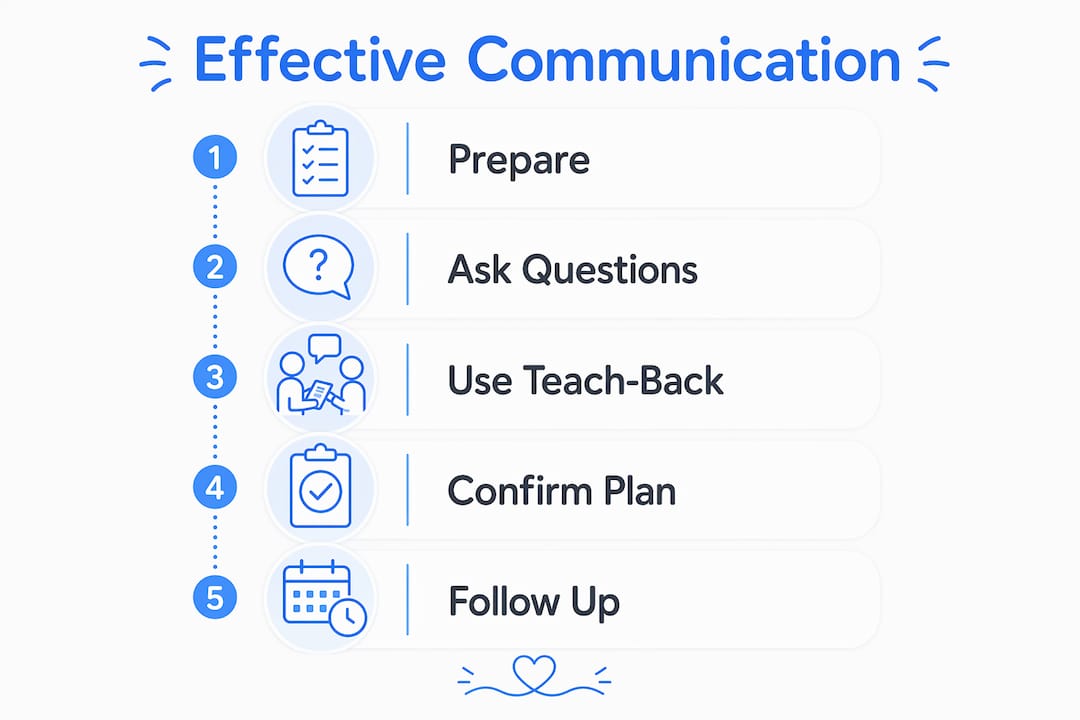
Start by building what some integrative medicine practitioners call a “regimen packet.” This is a written list of every therapy you use, including the product name, dose, timing, and the reason you are using it. Bring this document to every appointment. It signals that you are serious, organized, and focused on safety, not confrontation. Clinicians prefer transparent conversations and will engage far more willingly when you show your work.
Your preparation checklist should include:
- Full therapy list: Every supplement, topical, injection kit, or protocol you follow, with doses and frequency
- Current medications: Prescription and over-the-counter, with dosages
- Medical history summary: Relevant diagnoses, previous treatments, and outcomes
- Specific questions: Written down in advance, prioritized by urgency
- Your communication goal: One sentence stating what you want from this appointment
Pro Tip: Write your single most important question at the top of your list and hand it to your doctor at the start of the appointment. This prevents the clock running out before you reach what matters most.
The teach-back technique is worth knowing before you walk in. After your doctor explains a plan or gives an opinion, you say: “Let me make sure I understood that correctly” and restate what you heard. Teach-back methods improve accuracy and reduce the chance of leaving with a misunderstanding that costs you weeks of wrong decisions. Go in ready to listen, not just to be heard.

How to frame your conversation for clarity and safety
The way you open the conversation shapes everything that follows. Framing your therapies as complementary rather than alternative is not just a word game. It is a clinical signal. Doctors are trained to push back hard when patients say they want to replace a standard treatment. They are far more open when you say you want to add something and you want their input on safety.
Here is a practical sequence for structuring the conversation:
- State your goal first. “I want to talk about some additional approaches I’ve been using and make sure they’re safe alongside my current treatment.”
- Present your regimen packet. Hand it over. Let them read it. Do not summarize verbally while they are trying to read.
- Explain your rationale. “I started using this because of X symptom. I found this source. I want your opinion on whether it makes sense.”
- Ask about interactions directly. “Are there any interactions between this and my current medications that concern you?”
- Ask about monitoring. “If I continue this, what should we track to know whether it’s helping or causing harm?”
- Request documentation. “Can we note this in my chart so the whole team knows what I’m doing?”
Closed-loop communication is the clinical standard for reducing misunderstandings. It means asking your provider to restate the key decisions made during the appointment. You are not being difficult. You are using the same technique hospitals use to prevent medication errors.
Pro Tip: If your doctor seems rushed, say: “I have three specific questions. Can we get through all three before I leave?” Naming the number creates a commitment and keeps the conversation from drifting.
Multidisciplinary team input is the gold standard for integrative therapy safety review. If your care involves a dermatologist, a primary care physician, and a pharmacist, ask each of them to document their opinion on your complementary therapies. Conflicting advice across providers is a red flag worth surfacing early.
Common barriers and how to push through them
Most patients with Morgellons or Lyme disease have already hit a wall with at least one doctor. The dismissal is real, and it is awful. But understanding why it happens gives you a way through it instead of just a reason to give up.
The most common barriers on the patient side include:
- Fear of ridicule: Many patients stay silent because they expect their doctor to mock or dismiss their choices. This fear is understandable, especially for Morgellons patients who have faced mismatched explanations and dismissive language from providers who do not recognize the condition.
- Assuming the doctor won’t know: 70.2% of patients cite lack of clinician initiative as a barrier, and 37% believe their doctor simply doesn’t know enough about CAM. Both may be true. But your doctor doesn’t need to be a CAM expert to review your regimen for safety.
- Not knowing what to say: Silence is the default when patients lack a script. That is fixable.
On the clinician side, the barriers are time pressure, discomfort with uncertainty, and genuine knowledge gaps about integrative therapies. Doctors are not trained extensively in CAM, and many feel exposed when patients ask about it. This is not a reason to back down. It is a reason to bring your own sources and frame the conversation around safety review rather than endorsement.
For Morgellons patients specifically, the language problem is severe. Shared language between patient and provider is the foundation of productive care. When that language doesn’t exist, conversations collapse into defensiveness on both sides. The fix is to state your communication goals explicitly at the start: “I’m not here to argue about diagnosis. I want to talk about symptom management and make sure what I’m doing is safe.”
Persistence matters. One bad appointment does not close the door permanently. Respectful follow-up, a second opinion, or a referral to an integrative medicine specialist are all legitimate next steps.
What to say: scripts and questions for your appointment
Having the actual words ready removes the anxiety of improvising under pressure. These scripts are designed for chronic illness patients talking about holistic treatments with providers who may be skeptical.
For disclosing alternative therapy use:
- “I’ve been using [therapy name] for [symptom] for [time period]. I want to make sure it’s safe with everything else I’m taking.”
- “I found this approach through [source]. I’m not asking you to endorse it. I’m asking you to help me use it safely.”
- “I know this isn’t a standard treatment. I want to keep you informed so we’re working together.”
For asking questions about safety and interactions:
| Question | Why it matters |
|---|---|
| “Does this interact with any of my current medications?” | Identifies pharmacological conflicts before harm occurs |
| “What symptoms should I watch for that would tell me to stop?” | Creates a safety exit plan you both agree on |
| “Can we run labs to establish a baseline before I continue?” | Gives objective data to evaluate effect over time |
| “What’s your concern about this therapy specifically?” | Opens dialogue instead of triggering a flat refusal |
| “Who else on my care team should know about this?” | Activates multidisciplinary review without you having to coordinate it alone |
For Morgellons and Lyme patients, asking about diagnostic due diligence is particularly useful. Requesting Lyme testing, discussing anti-inflammatory properties of certain anti-infectives, and asking what monitoring exists for your symptom profile all move the conversation from adversarial to clinical. Dermatologists, in particular, respond well when patients frame requests around objective testing rather than treatment belief.
Ask your pharmacist too. Pharmacists are underused in this process. They have specific training in drug and supplement interactions that most physicians do not, and they are usually far more accessible for a quick conversation.
Key takeaways
Patients who prepare a written regimen packet, use closed-loop communication, and frame therapies as complementary rather than alternative get more productive appointments and safer outcomes.
| Point | Details |
|---|---|
| Prepare a regimen packet | List every therapy, dose, timing, and rationale before your appointment. |
| Frame therapies as complementary | Saying “alongside” instead of “instead of” keeps doctors engaged rather than defensive. |
| Use closed-loop communication | Ask your provider to restate key decisions to confirm shared understanding. |
| State your communication goal | Open with one sentence about what you want: safety review, symptom discussion, or monitoring plan. |
| Involve your pharmacist | Pharmacists catch drug-supplement interactions that physicians often miss. |
What I’ve learned about these conversations after years of fighting
I won’t pretend these conversations are easy. I’ve sat in offices where the doctor looked at me like I was speaking a foreign language. I’ve felt the shame of watching someone’s face go blank when I mentioned bee venom therapy or snow mushroom protocols. It’s a specific kind of awful, especially when you’re already exhausted from fighting your own body every single day.
But here’s what I know now that I didn’t know at the start. Doctors are not the enemy. Most of them genuinely want to help. The problem is that they are working from a completely different map than we are. When I started bringing my written regimen to appointments, something shifted. I wasn’t just a patient with strange ideas anymore. I was a patient with organized information and specific questions. That changes the dynamic completely.
The biggest mistake I see people make is walking in ready for a fight. I get it. After being dismissed enough times, defensiveness becomes armor. But armor closes doors. Curiosity opens them. When I started asking “what concerns you specifically about this?” instead of defending my choices, I started getting real answers. Sometimes those answers changed what I was doing. That’s not defeat. That’s exactly how this is supposed to work.
I also learned that one doctor’s dismissal is not a verdict. I’ve worked with patients who found one integrative-minded physician who changed the entire trajectory of their care. If you want support navigating that search, an onboarding consultation with someone who has lived this can help you figure out what to say and who to say it to.
Patience and preparation are not passive. They are the most powerful tools you have.
— Megan
How Megansmiraclestudio supports your path forward
At Megansmiraclestudio, we built everything around one truth: people with Morgellons and Lyme disease deserve real support, not just sympathy. Our product line, including the Medical Grade Bee Venom Therapy Kit and Snow Mushroom Polysaccharide Capsules, is designed to complement your medical care, not replace it. Every product comes with educational resources so you can walk into your next appointment knowing exactly what you’re using and why. When you’re ready to talk to your doctor about your regimen, we want you to feel prepared, confident, and supported every step of the way.
FAQ
What does “complementary” vs “alternative” therapy mean?
Complementary therapy works alongside conventional medical treatment, while alternative therapy replaces it. Clinicians are far more receptive to complementary framing, so using that language in appointments produces better conversations.
Why do so few patients discuss CAM with their doctors?
Research shows only 23.5% of patients raise CAM with their providers, most often because neither side initiates the conversation. Patients fear dismissal, and clinicians rarely ask.
How do I bring up alternative therapies without being dismissed?
Prepare a written list of every therapy with doses and rationale, state your communication goal at the start of the appointment, and frame everything as a safety review rather than a request for endorsement.
What questions should I ask about alternative therapies?
Ask about drug interactions, what symptoms would signal you to stop, whether baseline labs make sense, and who else on your care team should be informed. These questions shift the conversation from belief to clinical management.
How do Morgellons patients handle communication barriers with doctors?
Stating explicit communication goals focused on symptom management and safety, rather than diagnosis debates, reduces adversarial dynamics. Asking about diagnostic testing and anti-inflammatory treatment options also moves conversations in a more productive direction.